


“We see our curriculum as cumulative and layered rather than day-dependent; key skills are intentionally revisited so children build secure foundations before moving forward.”

Introducing Focus Activities
Ashleigh, Jenna and Eireann work together to produce Focussed activity sessions with a differentiated curriculum for all the children who attend Lilly Brook by having three different levels of challenge.
The Tadpoles - This group focusses on Language acquisition, attention and listening skills, and co regulation skills.
Froglets Group - This group focusses on deepening engagement and introducing early knowledge in mathematics and literacy whilst continuing to strengthen the prime areas.
Frogs Group - This group focuses on developing confident communicators and independent learners who can articulate ideas, explore new knowledge and think critically.
What Does a Focussed activity look like?
At Lilly Brook we have a daily focus activity each morning starting from 09:30 am.
We have three groups based on ability designed to challenge the children to learn new concepts which later can be applied to generalised play supporting our social constructivist model.
These sessions focus on all 7 areas of development.
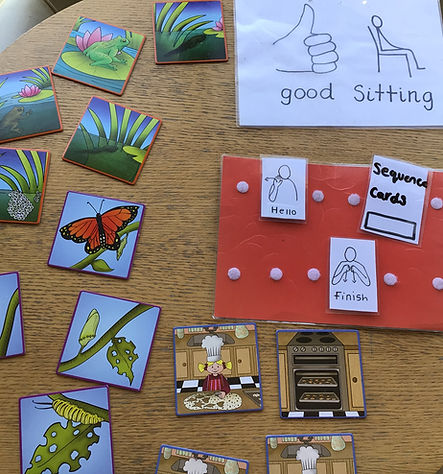
We sit on shape mats in a semi circle with Ashleigh or Jenna and we explain what we will be learning about or doing in each session using visual timetables. This is powered by the children's interests.
At the end of a section we post the image into the post box to signify the end and what comes next. Once all activities are finished we return to the free flow of the room.


Expressive Arts and design meets understanding of the world
Afternoon Focus

Skills Developed Across the Year
-
Sustained listening and attention
-
Rhythm, beat, tempo and pitch awareness
-
Musical vocabulary and knowledge
-
Vocabulary development and expressive language
-
Understanding of past and present and how music changes over time
-
Cultural awareness and appreciation of diversity
-
Emotional expression and emotional literacy
-
Gross motor coordination and body control
-
Creativity, imagination and experimentation
-
Confidence in participation, movement and performance
-
Making comparisons, connections and observations
-
Developing curiosity about people, places, cultures and the wider world

Our afternoon focus sessions are carefully planned to develop children’s expressive arts and design skills while strengthening communication, listening and physical development.
Children explore music and movement using scarves, rhythm instruments and visual supports. Sessions are structured to build listening skills, rhythm awareness and coordinated movement. Adults model musical vocabulary such as beat, rhythm, tempo, loud, quiet, fast and slow, helping children to develop a growing understanding of musical concepts.
Music Across the Eras and Around the World
As part of our wider curriculum, we introduce children to a diverse range of music, exploring music across different eras as well as music from around the world. This year, our musical journey will reflect the children's interests and curiosity, giving them opportunities to notice how music has changed over time, from older musical styles through to music they recognise today. We will also explore music from different countries and cultures, helping children to develop an appreciation of the many ways music is created, shared and enjoyed.
We begin by using images, objects, stories and experiences to introduce the context behind the music. Children may explore photographs of musicians, instruments, historical periods, places and cultural celebrations to spark conversation and curiosity. Adults encourage children to observe closely, ask questions, make comparisons and share what they already know, supporting vocabulary development and expressive language.
Children will listen to a variety of musical styles, developing their ability to listen carefully, recognise differences and similarities, and respond to changes in rhythm, tempo, pitch and volume. We will talk about how music from different eras and cultures may sound different and consider how music can tell us something about the people, places and times in which it was created.
Children will have opportunities to move, dance, sing and respond creatively to the music they hear. They will use instruments to explore and recreate rhythms, experiment with sounds and develop their understanding of beat and pattern. Scarves and other resources will encourage children to express themselves through imaginative movement and respond physically to different tempos and musical moods.